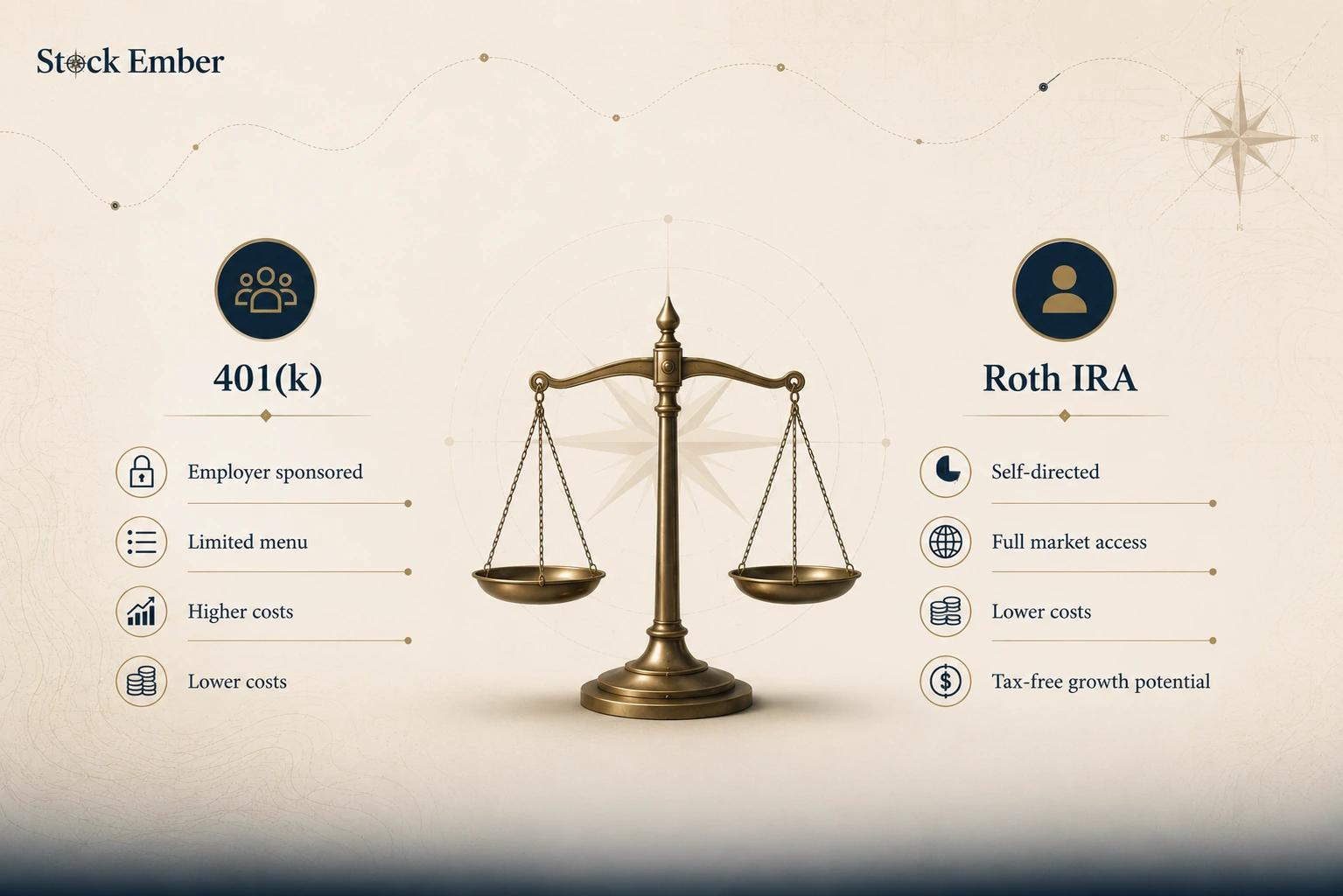
A 401(k) is an employer-sponsored retirement account with higher annual contribution caps ($24,500 in 2026), while a Roth IRA is an individual account offering tax-free growth and flexible investment choices. Most long-term investors prioritize securing any employer 401(k) match first before allocating funds to a self-directed Roth IRA.
A 401(k) is an employer-sponsored retirement plan offering high annual contribution limits, while a Roth IRA is an individual after-tax account offering tax-free growth and complete investment flexibility.
Deciding how to split your long-term savings between a workplace 401(k) and a self-directed Roth IRA shapes your future tax burden and current investment choices. The right account order depends on whether you have access to an employer match, your current tax bracket, and your desire for broad asset choice. This guide compares both wrappers, examines the cost of restricted plan menus, and outlines a step-by-step account funding priority.
Quick Takeaways
01Workplace 401(k) plans allow significantly higher annual contribution limits ($24,500 in 2026) compared to Roth IRAs ($7,500), according to the IRS's 2026 retirement plan limit announcement.
02You should prioritize funding your 401(k) up to your employer match before allocating money to an individual Roth IRA, capturing an immediate return on matched dollars.
03A Roth IRA provides complete investment freedom and penalty-free access to your original principal contributions at any time.
04If your employer offers a Roth 401(k) option, you can combine workplace contribution capacity with tax-free growth in retirement.
What Is the Difference Between a 401(k) and a Roth IRA?
A 401(k) is a workplace retirement plan bound to an employer-selected menu, whereas a Roth IRA is an individually owned account wrapper providing access to open brokerage markets.
When evaluating a 401k vs roth ira strategy, understanding account ownership is the primary starting point. A 401(k) is established by your employer. Your contributions are automatically deducted from your paycheck and placed into a curated menu of mutual funds chosen by the plan administrator.
In contrast, to understand how does a roth ira work, remember that it is an individual tax wrapper you open directly at a brokerage custodian of your choice. To understand the core mechanics of this individual wrapper, read our foundational guide on what is a roth ira.
Because you own the account directly, a Roth IRA lets you invest in almost any low-cost ETF, individual stock, or index fund available on the open market, freeing you from restrictive workplace investment menus.
Balance scale comparing 401(k) employer-sponsored features against Roth IRA self-directed features
Key Comparison: Roth IRA vs. 401(k) Features
Comparing a Roth IRA and a workplace 401(k) highlights key trade-offs between high contribution capacity, tax treatment, and account control.
While both vehicles help buy-and-hold investors build multi-decade wealth, their operational rules differ across several core dimensions:
Feature
Workplace 401(k)
Individual Roth IRA
Account Ownership
Tied to employer plan
Individually owned at a brokerage
2026 Contribution Limit
$24,500 ($32,500 if 50+)
None
Tax Treatment
Typically pre-tax (Traditional)
After-tax (Roth tax-free growth)
Income Caps
No income eligibility limits
Income Caps — MAGI (Modified Adjusted Gross Income) phase-outs apply
Investment Universe
10–30 employer-selected funds
Full universe of ETFs, stocks, bonds
Early Liquidity
Loans/penalties before 59½
Principal contributions withdrawable anytime
Understanding Roth 401(k) vs. Roth IRA Options
A Roth 401(k) is an after-tax workplace plan option that pairs the high contribution cap of a 401(k) with the tax-free withdrawals of a Roth structure.
Many investors assume that all 401(k) accounts use pre-tax dollars. However, many modern employers offer a roth 401k option alongside the traditional pre-tax 401(k). Comparing roth 401k vs roth ira mechanics clarifies how tax-free growth functions across workplace and individual wrappers.
When comparing a roth 401k vs 401k (traditional pre-tax), the difference lies in tax timing. A traditional 401(k) gives you an immediate tax break today, but you pay ordinary income tax on withdrawals in retirement. A Roth 401(k) uses after-tax payroll deductions, granting tax-free growth and tax-free distributions in retirement—just like a Roth IRA.
However, key differences remain when comparing a roth 401k vs roth ira:
Contribution Capacity: A Roth 401(k) allows you to save up to $24,500 in after-tax dollars annually, whereas a Roth IRA caps after-tax contributions at $7,500 in 2026, per IRS guidance..
Income Limits: High earners barred from direct Roth IRA contributions due to income caps can still contribute directly to a workplace Roth 401(k) without income restrictions.
Investment Selection: A Roth 401(k) remains restricted to your employer's plan lineup, while a Roth IRA grants unlimited asset choice.
Traditional vs. Roth Tax Treatment Across Accounts
Traditional retirement contributions offer immediate tax deductions today, while Roth structures lock in tax-free distributions in retirement.
Choosing between pre-tax traditional contributions and after-tax Roth contributions across either a 401(k) or an IRA depends on your current tax bracket compared to your anticipated tax rate in retirement:
Use Pre-Tax 401(k) or Traditional IRA if: You are currently in a high income tax bracket and want to lower your current taxable income today.
Use Roth IRA or Roth 401(k) if: You are currently in a lower tax bracket, expect your income or tax rates to rise over time, or value tax-free withdrawals in retirement.
To evaluate how pre-tax and after-tax individual accounts compare in detail, see our analysis on roth ira vs traditional ira
How to Prioritize Funding Both Accounts (The Allocation Waterfall)
The most efficient strategy for funding both accounts involves securing your employer match first, then filling your Roth IRA, and returning to your 401(k).
Rather than choosing strictly between a 401(k) and a Roth IRA, most long-term investors combine both accounts using a structured waterfall approach:
Step 1: Capture 100% of Your Employer Match. Contribute enough to your workplace 401(k) to collect every dollar of employer matching funds. An employer match effectively adds an immediate 50% to 100% boost to your contributed dollars, a benefit no standalone account can replicate, though the actual value depends on your plan's vesting schedule.
Step 2: Max Out Your Roth IRA. Direct your next investment dollars into an individual Roth IRA up to the $7,500 annual limit. This grants you access to ultra-low-cost ETFs, eliminates administrative plan fees, and secures penalty-free principal liquidity.
Step 3: Return to Fill Remaining 401(k) Capacity. If you have additional long-term savings available after maxing out your Roth IRA, increase your 401(k) contributions up to the $24,500 annual deferral cap.
Step 4: Utilize Taxable Brokerage Accounts. Once your tax-advantaged account wrappers are fully funded, direct remaining savings into a standard taxable brokerage account.
Conclusion
Both workplace 401(k) plans and individual Roth IRAs serve distinct, complementary roles in a long-term wealth accumulation plan. A 401(k) offers unmatched contribution capacity and the instant benefit of employer matching funds, while a Roth IRA provides complete investment selection, low-cost ETF access, and tax-free withdrawals. By prioritizing your employer match first and then filling your self-directed Roth wrapper, you may improve your tax efficiency and reduce long-term investment costs, though actual outcomes depend on market performance, fees, and your individual tax situation.
When you are ready to open an individual tax wrapper or compare platform providers, our independent broker reviews offer a complete look at custodian fees, investment choices, and platform features.
FAQ
3 questions
What is the difference between a Roth 401(k) and a Roth IRA?
Both accounts offer tax-free investment growth and tax-free withdrawals in retirement, but they differ in setup and rules. A Roth 401(k) is a workplace plan with higher contribution caps ($24,500 in 2026) and no income limits, but restricted fund choices. A Roth IRA is an individual account with lower limits ($7,500 in 2026), income caps, and broad market investment options.
What happens to my 401(k) when I change jobs?
When leaving an employer, you can leave your 401(k) balance in the old plan (if permitted), roll it over into your new employer's 401(k) plan, or execute a tax-free rollover into an individual IRA (Traditional or Roth, depending on account tax types). Rolling over into an individual IRA typically gives you lower investment fees and greater portfolio control.
Can I contribute to both a 401(k) and a Roth IRA at the same time?
Yes, you can contribute to both a workplace 401(k) and an individual Roth IRA in the same tax year, provided you satisfy the income eligibility requirements for the Roth IRA. Contributing to both accounts allows you to combine high workplace contribution limits with the tax-free growth and investment flexibility of a Roth account.
Disclaimer
This guide was written with AI assistance and reviewed by the StockEmber editorial team for accuracy. StockEmber provides independent education, not personal financial advice. Some links may support our work at no additional cost to you.
The StockEmber Team is our in-house desk of independent research writers. We test brokerage platforms, read the fine print on fees and custody, and cover ETFs and long-horizon investing for people who plan to hold for decades — not days.