

The 2026 Economic Policy Symposium at Jackson Hole, scheduled for August 27–29 according to the Federal Reserve Bank of Kansas City, is expected to address key policy projections regarding inflation metrics, interest rate paths, and broad labor market conditions.
Here's what equity investors should watch for. When central bankers gather, financial headlines often trigger immediate market swings. However, parsing a Fed Chair Jackson Hole speech summary requires separating short-term sentiment from long-term fundamental compounding, ensuring your decade-long investment strategy remains untouched by temporary news cycles.
Our Jackson Hole 2026 summary breaks down what the Fed Chair is expected to signal and how markets may respond.
Quick Takeaways
- The 2026 Jackson Hole symposium is expected to reinforce a data-dependent central bank framework, prioritizing long-term price stability over aggressive monetary accommodation.
- Equity markets are expected to see localized volatility during the keynote address, with rate-sensitive sectors likely to show the sharpest immediate divergence.
- Long-horizon investors benefit most by treating central bank proceedings as background economic context rather than catalysts for short-term portfolio rebalancing.
Recap of Jackson Hole 2026: Headline Remarks & Policy Signals
The 2026 Jackson Hole Economic Policy Symposium is expected to focus on balancing persistent structural economic trends against broader macroeconomic expansion goals. Held annually by the Federal Reserve Bank of Kansas City in Wyoming, this event brings together global central bankers, academics, and policymakers to discuss long-term policy structures.
In addressing what the Fed is expected to say at Jackson Hole 2026, the central bank keynote is likely to center on structural shifts in economic productivity, supply chain resilience, and labor dynamics. The central bank is expected to emphasize that future policy benchmark rate decisions will rely strictly on incoming monthly data rather than fixed, forward-looking calendars.
While market commentators will likely dissect every sentence for micro-signals, the core policy message is expected to remain centered on institutional discipline: keeping long-term inflation expectations anchored while allowing the real economy to absorb historic rate changes.
Keynote Tone: Decoding the Central Bank’s Stance
The overall tone expected from the 2026 keynote speech is likely to reflect a pragmatic, balanced policy approach rather than an aggressive hawkish or dovish pivot. Central bankers are expected to signal confidence that monetary settings over recent cycles have successfully restricted inflationary pressures without creating systemic distress across the financial sector.
Analysts anticipate the Jackson Hole meeting result will reveal a central bank that is content to keep borrowing costs disciplined until economic indicators offer overwhelming evidence in either direction. Rather than committing to a rapid series of rate reductions or unexpected tightening, the policy framework remains anchored to neutrality.
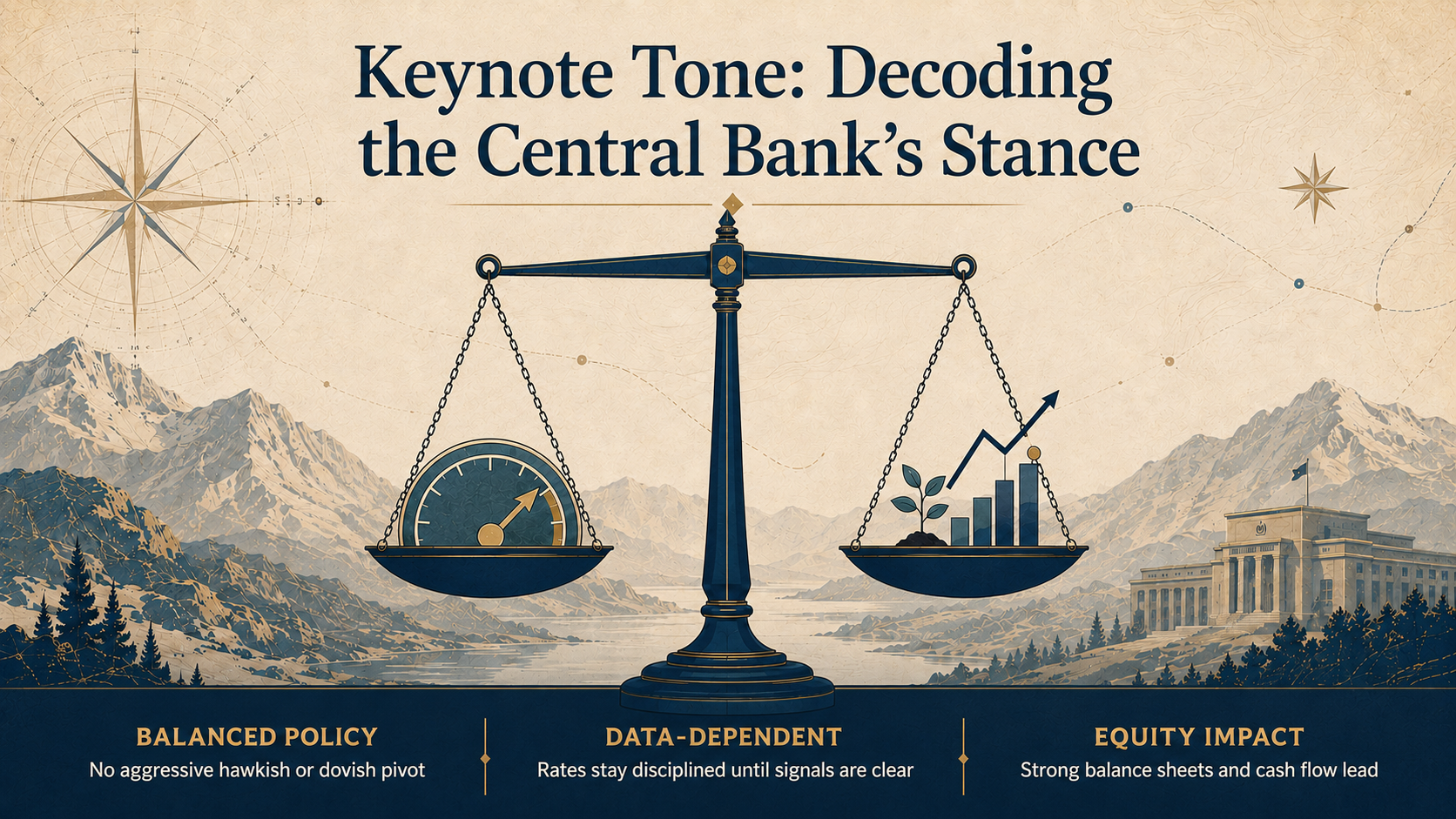
For long-term equity investors, this measured stance means borrowing costs for major corporations will likely normalize at levels slightly higher than the near-zero environments seen in past decades. Businesses with robust balance sheets and organic cash flow generation are structurally positioned to handle this baseline far better than highly levered enterprises reliant on cheap capital.
How Markets Reacted: Major Indices and Key Sectors
Stock market reaction to the 2026 Jackson Hole address is expected to see major benchmark indices absorb the policy guidance with initial intraday fluctuations followed by sector-level reallocation. Broad equity benchmarks, including the S&P 500 and Nasdaq Composite, may initially fluctuate as traders parse the transcript before settling into a stable trend.
Evaluating the broad Jackson Hole impact on market segments shows clear variance across asset classes:
- Technology & Growth Equities: Rate-sensitive, high-multiple growth stocks may experience modest intraday repricing as terminal rate expectations stabilize.
- Real Estate & Utilities: High-yield dividend sectors are likely to respond directly to movements in 10-year Treasury yields, reflecting shifted income expectations.
- Defensive & Value Stocks: Established value enterprises with steady cash flows may show relative stability, benefiting from reduced economic uncertainty.
Evaluating whether Jackson Hole 2026 turns out to be good or bad news for stocks will depend on an investor's time horizon. For intraday speculators seeking aggressive monetary stimulus, the absence of explicit rate-cut guarantees might feel restrictive. However, for long-term equity investors, central bank clarity and economic stability represent a healthy baseline for long-horizon earnings growth.
What’s Next for Stock Investors: Positioning & Long-Term Context
This part of our Jackson Hole 2026 summary focuses on what long-term investors should do next.
Following the Jackson Hole symposium, the primary focus for stock investors shifts to incoming monthly inflation data and scheduled Federal Open Market Committee (FOMC) interest rate decisions. Central bank speeches set the theoretical framework, but concrete economic reports dictate actual policy adjustments.
When considering what's next for markets after Jackson Hole, long-term investors should avoid the temptation to overhaul portfolio allocations based on central bank headlines. Macroeconomic shifts happen over multi-year cycles, whereas short-term market reactions often reverse within days.
Maintaining a regular dollar-cost averaging (DCA) routine into diversified index funds remains one of the most effective ways to navigate central bank cycles. By continuously acquiring broad market assets across varying interest rate environments, you automatically eliminate the need to forecast central bank policy moves accurately.
Common Pitfalls: Central Bank Noise vs. 10-Year Portfolio Growth
Overreacting to macroeconomic headlines from central bank speeches is one of the most common behavioral traps for equity investors. Media coverage surrounding events like Jackson Hole often creates a false sense of urgency, prompting investors to make frequent, emotional adjustments to their portfolios.
Consider the friction costs of tactical trading. If an investor attempts to time market shifts around central bank announcements, trading commissions, foreign exchange fees, bid-ask spreads, and potential capital gains taxes can easily create an annual friction drag of 0.5% to 1.0%.
Over a 10-year horizon, a 1.0% annual friction cost quietly erodes roughly 10% of your total portfolio accumulation compared to a static buy-and-hold strategy. Fees and trading friction compound against your portfolio over time in the exact same manner that investment returns compound for you.
10-Year Impact of Annual Trading Friction (Illustrative)
| Item | Impact / Value |
|---|---|
| Static Buy-and-Hold Strategy | 100% Potential Growth |
| Tactical Portfolio Adjustments | -10% Lost to Fees & Drag |
| Net 10-Year Portfolio Value | 90% Retained |
By focusing on long-term enterprise value creation rather than central bank commentary, buy-and-hold investors keep their capital working efficiently without incurring unnecessary friction.
Conclusion
This Jackson Hole 2026 summary highlights the Fed's data-dependent stance and its early market implications.
The 2026 Jackson Hole symposium is expected to provide essential policy context, confirming that central bankers remain focused on long-term economic stability through data-dependent monetary settings. While short-term market fluctuations following the keynote speech may draw media attention, the underlying economic foundation for broad equity markets remains tied to corporate earnings and business productivity over the decade ahead. When you're ready to choose where to hold your long-term index investments, our broker reviews are the place to start.