A Custodial Roth IRA is an individual retirement account established by an adult custodian for a minor child who has documented earned income. Contributions grow completely tax-free over multi-decade compounding horizons, and original principal contributions can be withdrawn at any time tax- and penalty-free.
A Custodial Roth IRA is an individual retirement account opened by an adult custodian for a minor who has earned income, enabling tax-free investment growth across a multi-decade compounding horizon.
Starting a retirement account during a child's teenage years is one of the most effective ways to build long-term financial security. Giving investments four or five decades to grow without tax drag dramatically reduces the capital needed to achieve financial independence. This guide breaks down eligibility requirements, IRS earned income rules, and account transition mechanics.
Quick Takeaways
01An adult manages the Custodial Roth IRA as custodian, but the minor child remains the legal beneficial owner of all account assets.
02The child must have documented earned income from a W-2 job or legitimate self-employment to qualify for contributions.
03Annual contributions cannot exceed the child's total earned income for the tax year or the IRS cap of $7,500 in 2026 (IRS Publication 590-A).
04All account growth compounds tax-free, and original principal contributions can be withdrawn at any time without taxes or penalties.
05Legal control automatically transfers to the child when they reach their state's legal age of majority (typically 18 to 21).
What Is a Custodial Roth IRA and How Does It Work?
A Custodial Roth IRA is a tax-sheltered individual retirement account established by an adult for a minor child who earns income.
In this account structure, the adult acts as the custodian responsible for executing trades, managing assets, and choosing investments. However, the minor child is the sole beneficial owner of every dollar held within the wrapper.
Contributions are made using after-tax income, meaning there is no upfront tax deduction. In exchange, every dividend, interest payment, and capital gain earned inside the portfolio compounds completely tax-free. Because the wrapper protects the portfolio from annual dividend and capital gains taxes, the child's capital compounds without the annual tax drag present in standard brokerage accounts.
The IRS Earned Income Rule: The Mandatory Prerequisite
The IRS requires a minor child to have legitimate earned income in the tax year a contribution is made to a Custodial Roth IRA.
A child cannot fund a Roth IRA using allowances, gifts, inheritance, or investment returns. To qualify, the compensation must fit the official IRS definition of earned income:
Taxable Compensation (W-2): Wages earned from regular employment, such as working at a restaurant, retail store, or summer camp.
Self-Employment Income: Money earned from documented personal services, such as babysitting, lawn mowing, dog walking, or neighborhood tutoring.
For 2026, the maximum annual contribution is $7,500 or 100% of the child's total earned income for the year, whichever amount is smaller (IRS Publication 590-A) For example, if a teenager earns $3,000 working a summer job, their maximum contribution limit for that year is $3,000.
Parent Matching Strategies and Recordkeeping
Parents or family members are legally permitted to gift money to fund the child's Custodial Roth IRA, provided the total deposit does not exceed the child's actual earned income for the year. This allows working teens to keep their earned cash for personal expenses while parents fund the tax wrapper on their behalf.
For self-employment work, maintaining meticulous recordkeeping is essential. Keep a dedicated log documenting dates, exact services performed, payment amounts, and client names to satisfy IRS validation requirements in the event of an audit.
The Power of 40-Year Compounding
Starting a Roth IRA during a child's teenage years extends the compounding timeline to 40 or 50 years, exponentially magnifying potential wealth.
Time is the single greatest multiplier in passive investing. To see how starting early transforms small savings, consider a 15-year-old who deposits a single lump sum of $3,000 into a Custodial Roth IRA returning an average of 7% annually:
In a Taxable Account: Annual tax drag on dividends and capital gains reduces the net compounding rate over decades, trimming thousands of dollars from the ultimate balance.
In a Custodial Roth IRA: The entire balance compounds uninterrupted. By age 65—after 50 years of growth—that single $3,000 deposit could hypothetically grow to roughly $90,000 — assuming a consistent 7% average annual return and no withdrawals over 50 years. Actual returns will vary depending on market conditions, investment selection, and fees, and there is no guarantee the portfolio will achieve this outcome.
Chart showing $3,000 Custodial Roth IRA growing to $90,000 over 50 years at 7% annual return
Legal Transfer at Age of Majority & FAFSA Impact
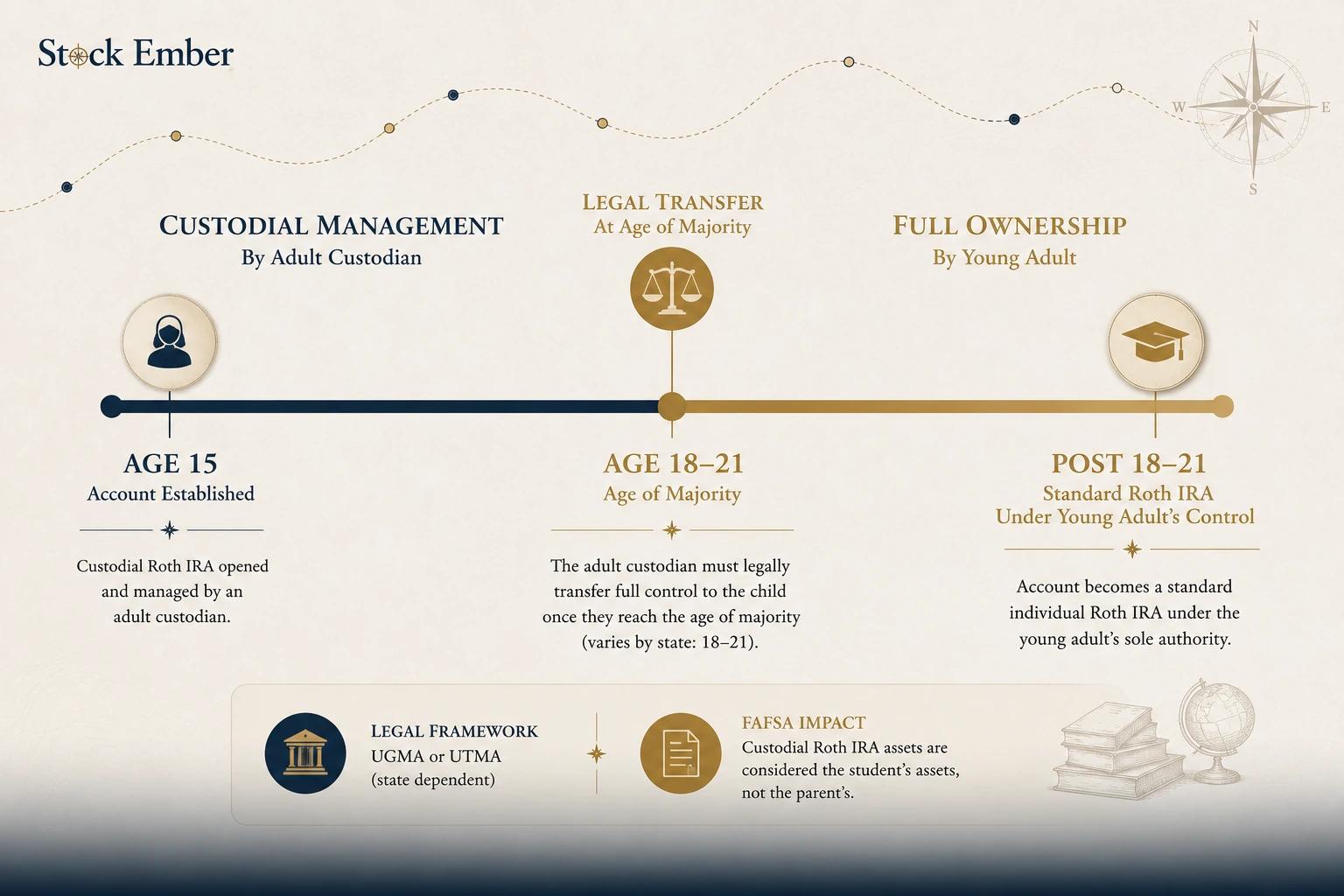
Full legal control of a Custodial Roth IRA automatically transfers from the adult custodian to the child once they reach the legal age of majority in their state.
Diagram illustrating Custodial Roth IRA account control transferring from parent custodian to young adult at age of majority
Depending on state law under Uniform Gifts to Minors Act (UGMA) or Uniform Transfers to Minors Act (UTMA) guidelines, the age of majority occurs between age 18 and 21. At that milestone, the adult custodian must hand over control, and the account transitions into a standard individual Roth IRA under the young adult's sole authority.
How Custodial Roth IRAs Affect College Financial Aid (FAFSA)
Understanding how retirement accounts affect higher education financial aid is crucial for family planning:
Account Balances as Assets: Unlike standard custodial brokerage accounts (UGMA/UTMA), retirement assets like a Custodial Roth IRA are generally exempt from asset calculations on the Free Application for Federal Student Aid (FAFSA).
Withdrawals as Income: However, if the young adult withdraws earnings or principal to pay for college expenses, those distributions may be treated as untaxed student income on future FAFSA forms, potentially reducing aid eligibility in subsequent years.
Custodial Roth IRA vs. Other Minor Savings & Global Wrappers
A Custodial Roth IRA focuses specifically on long-term tax-free wealth accumulation, whereas traditional minor savings accounts provide general flexibility without tax shelters.
Standard custodial brokerage accounts allow parents to invest cash gifts without earned income prerequisites, but they lack tax-deferred or tax-free growth benefits. Once a minor develops verified earnings, transitioning to a dedicated tax wrapper unlocks maximum long-term efficiency.
To explore how standard after-tax wrappers function once an individual reaches adulthood, read our complete guide on what is a roth ira.
For investors operating outside the US tax system, similar government-sponsored minor accounts exist worldwide. For instance, families in the UK utilize specialized tax-exempt wrappers for minors, as detailed in our guide on what is an isa account.
Common Custodial Roth IRA Mistakes to Avoid
Common errors include failing to document earned income, over-contributing past earned wages, and mismanaging early withdrawals.
To keep your child's account compliant and tax-efficient, watch out for these frequent mistakes:
Inadequate Earned Income Proof: Depositing funds without verifiable wage documentation (such as W-2 forms or detailed self-employment logs) can trigger IRS audits and excess contribution penalties.
Exceeding Annual Earned Income Caps: Contributing the full $7,500 limit when a teen only earned $2,000 creates an illegal excess contribution that incurs an annual 6% IRS penalty tax until corrected.
Assuming Parents Retain Control Indefinitely: Custodians cannot retain control after the child reaches the legal age of majority; legal ownership shifts entirely to the young adult.
Conclusion
A Custodial Roth IRA is an exceptional vehicle for introducing young earners to wealth building while sheltering multi-decade growth from taxes. By establishing verified earned income, leveraging early compound interest, and maintaining clean tax documentation, parents can give their children a head start toward lifetime financial independence. Understanding how early contributions compound will help you position tax-advantaged accounts effectively within your family's financial roadmap.
When you are ready to evaluate custodians, compare platform capabilities, or open an account, our independent broker reviews evaluate platform features, account minimums, and fee structures.
FAQ
4 questions
What counts as earned income for a Custodial Roth IRA?
Earned income includes taxable wages from traditional employment (like W-2 jobs at restaurants or retail stores) and documented self-employment work (such as babysitting, lawn mowing, or tutoring). Allowances, gifts, chores without official recordkeeping, and investment earnings do not count as earned income.
What happens to a Custodial Roth IRA when the child reaches the age of majority?
Once the child reaches their state's legal age of majority (typically 18 to 21 depending on jurisdiction), full legal ownership and operational control automatically transfer to the child. The adult custodian is removed, and the account converts into a standard individual Roth IRA under the young adult's sole authority.
Does a Custodial Roth IRA affect college financial aid (FAFSA)?
Assets held inside retirement accounts like a Custodial Roth IRA are generally excluded from asset calculations on the FAFSA, meaning the account balance does not reduce financial aid eligibility. However, if the child takes distributions from the account to pay for college, those withdrawals may be treated as untaxed student income on future FAFSA applications.
What is the maximum contribution limit for a Custodial Roth IRA in 2026?
In 2026, the maximum annual contribution limit for a minor's Custodial Roth IRA is $7,500 or 100% of the child's actual earned income for the tax year, whichever amount is smaller
Disclaimer
This guide was written with AI assistance and reviewed by the StockEmber editorial team for accuracy. StockEmber provides independent education, not personal financial advice. Some links may support our work at no additional cost to you.
The StockEmber Team is our in-house desk of independent research writers. We test brokerage platforms, read the fine print on fees and custody, and cover ETFs and long-horizon investing for people who plan to hold for decades — not days.