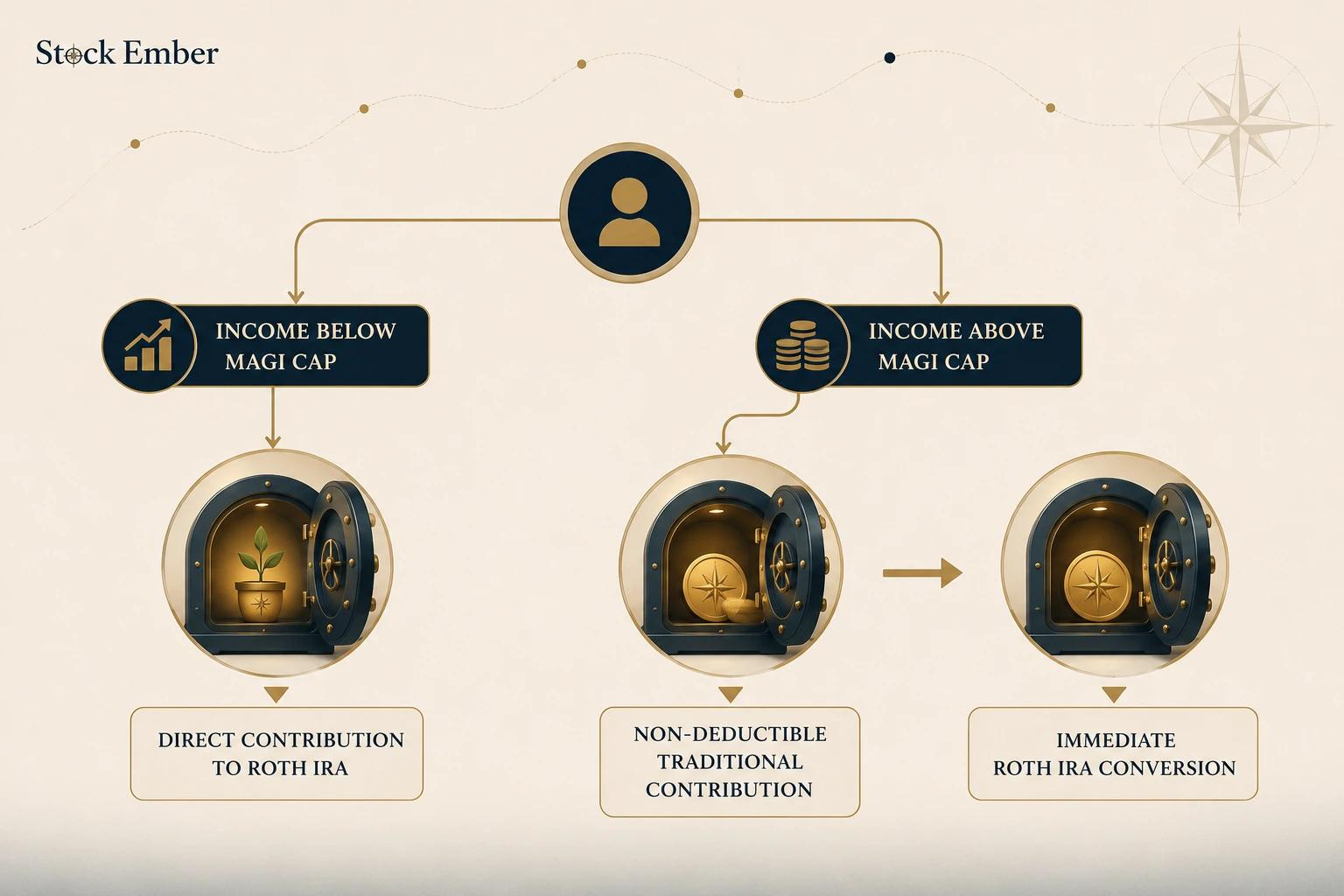
A Backdoor Roth IRA is a two-step tax strategy that allows high earners exceeding federal income limits to fund a Roth IRA indirectly. An investor makes a non-deductible contribution to a Traditional IRA and then converts those funds into a Roth IRA wrapper, securing tax-free investment growth.
A Backdoor Roth IRA is a two-step tax strategy that allows high-earning investors who exceed IRS income limits to fund a Roth IRA tax wrapper indirectly.
When your income crosses federal eligibility thresholds, direct contributions to a Roth account are restricted by law. By making a non-deductible contribution to a Traditional IRA and immediately converting those funds, you preserve access to decades of tax-free growth and penalty-free contribution liquidity. This guide explains how to execute the conversion, navigate the IRS pro-rata rule, and handle annual tax reporting.
Quick Takeaways
01The Backdoor Roth IRA is a legal, two-step conversion method that bypasses federal income limits on direct Roth IRA contributions.
02High earners contribute after-tax cash to a Traditional IRA and then convert those funds to a Roth IRA wrapper once settled.
03The IRS pro-rata rule aggregates all pre-tax Traditional, SEP, and SIMPLE IRA balances, which can create unexpected tax bills on conversion.
04Filing IRS Form 8606 every tax year is required to report non-deductible contributions and prevent double taxation.
What Is a Backdoor Roth IRA and Why Do High Earners Need It?
A Backdoor Roth IRA is a conversion strategy that lets high-income taxpayers access tax-free retirement growth when their income prevents direct Roth IRA contributions.
The Internal Revenue Service (IRS) enforces Modified Adjusted Gross Income (MAGI) phase-out thresholds that restrict direct contributions. For 2026, direct contribution eligibility begins phasing out at $153,000 for single filers (capping out at $168,000) and $242,000 for married couples filing jointly (capping out at $252,000). Once your income exceeds the upper threshold, your direct contribution limit drops to zero.
Because tax law places no income limits on making non-deductible contributions to a Traditional IRA or converting Traditional IRA funds to a Roth IRA, combining those two actions creates an accessible path to tax-sheltered compounding.
Comparison of Traditional IRA vs Roth IRA features
Step-by-Step: How to Execute a Backdoor Roth IRA
Executing a Backdoor Roth IRA involves depositing non-deductible funds into a zero-balance Traditional IRA and moving them into a Roth IRA as soon as the deposit clears.
To complete the transaction smoothly while minimizing accidental tax liabilities, follow this operational sequence:
Open and Fund a Traditional IRA: Open a Traditional IRA at your preferred brokerage (or use an existing account with a zero balance). Deposit after-tax cash up to the annual IRA cap—$7,500 for investors under age 50, or $8,600 for those 50 and older in 2026.
Leave Funds Uninvested: Keep the cash in the core settlement fund. Do not purchase stocks, ETFs, or mutual funds inside the Traditional IRA while waiting to convert.
Execute the Roth Conversion: Once the cash deposit settles (typically 1 to 3 business days), log into your account portal and request a full Roth conversion to transfer the balance into your Roth IRA.
Invest Inside the Roth IRA: Once the funds arrive in your Roth IRA wrapper, purchase your long-term assets, such as broad-market index ETFs.
Managing Settlement Interest
While waiting for your cash deposit to clear, your Traditional IRA core account may earn a few cents or dollars in sweep interest. If $7,500.50 settles and converts, you simply convert the full $7,500.50. You will owe ordinary income tax on the $0.50 gain in that tax year, but tiny residual interest does not void the transaction.
The IRS Pro-Rata Rule: The Primary Backdoor Trap
The IRS pro-rata rule requires the tax liability of a Roth conversion to be calculated across the aggregate balance of all your non-Roth IRAs.
Under tax law, the IRS does not allow you to isolate non-deductible cash for conversion if you hold pre-tax balances in other Traditional IRAs, SEP-IRAs, or SIMPLE IRAs. Instead, tax liabilities are determined by the ratio of your after-tax contributions to your total pre-tax IRA assets across all accounts as of December 31 of the conversion year.
How the Pro-Rata Math Works
Assume you contribute $7,500 in after-tax cash to a new Traditional IRA intending to perform a Backdoor Roth conversion. However, you also hold an old rollover IRA with $67,500 in pre-tax contributions.
Your total aggregate non-Roth IRA balance is now $75,000 ($67,500 pre-tax + $7,500 after-tax). Your after-tax basis represents exactly 10% ($7,500 ÷ $75,000) of your total IRA assets:
Description
Amount / Details
Total Aggregate IRA Balance
$75,000
After-Tax Contribution
$7,500 (10% of total)
Pre-Tax IRA Balance
$67,500 (90% of total)
Amount Converted
$7,500
Tax-Free Portion (10%)
$750
Taxable Portion (90%)
$6,750 (Taxed as ordinary income)
If you convert $7,500 to a Roth IRA, 90% ($6,750) of the conversion will be taxed as ordinary income in the current year.
How to Avoid the Pro-Rata Trap
If you hold pre-tax IRA balances, you can clear the pro-rata hurdle by executing a "reverse rollover." Check if your current employer’s 401(k) or 403(b) plan accepts incoming rollovers from Traditional IRAs. Moving your pre-tax IRA assets into an active workplace 401(k) removes those balances from the IRS pro-rata calculation, leaving your Traditional IRA balance at zero and clearing the path for tax-free conversions.
Tax Reporting: Navigating IRS Form 8606
Filing IRS Form 8606 with your annual tax return is the mandatory reporting requirement that establishes your after-tax contribution basis.
Form 8606 informs the IRS that your Traditional IRA contribution was made with after-tax money and should not be taxed a second time upon conversion. When filing your annual tax return:
Part I records your non-deductible Traditional IRA contribution basis.
Part II documents the conversion from your Traditional IRA to your Roth IRA.
Failing to file Form 8606 can result in an IRS penalty and may lead the IRS to treat your conversion as fully taxable pre-tax income.
Backdoor Roth IRA vs. Direct Roth IRA vs. Custodial Accounts
A Backdoor Roth IRA provides identical long-term tax protection as a direct Roth IRA, differing only in the administrative mechanics required for entry.
Once funds settle inside your Roth IRA container, they benefit from tax-free compounding, tax-free qualified withdrawals in retirement, and freedom from lifetime Required Minimum Distributions (RMDs). To learn more about standard wrapper rules, see our main guide on what is a roth ira
High-earning parents who want to establish tax-sheltered compounding for children with earned income can also establish a custodial roth ira, which operates under standard minor contribution limits regardless of parent income.
Common Mistakes to Avoid
Avoiding operational errors ensures your conversion remains tax-efficient and compliant with federal tax code requirements.
Watch out for these common implementation mistakes:
Investing Cash Before Converting: Purchasing mutual funds or ETFs inside the Traditional IRA while waiting to convert can create taxable short-term capital gains if the asset appreciates before conversion.
Forgetting the December 31 Pro-Rata Date: The IRS evaluates your total aggregate IRA balances on December 31 of the tax year in which the conversion occurs, not the date you make the initial contribution.
Skipping Form 8606: Omitting this form from your annual tax filing creates tax discrepancies with the IRS, potentially taxing your after-tax contribution.
Conclusion
A Backdoor Roth IRA provides high earners with an effective, compliant strategy to secure tax-free growth and protect multi-decade compound returns from future tax liabilities. By confirming a zero pre-tax IRA balance, executing the two-step conversion without delay, and documenting the transaction on Form 8606, you can preserve access to one of the most powerful tax wrappers available. Evaluating your existing account balances today will determine whether a clean conversion path is ready for your portfolio.
When you are ready to evaluate platform features and select a brokerage custodian for your conversion, our independent broker reviews offer a complete comparison of account capabilities, service quality, and platform fees.
FAQ
3 questions
How does the IRS pro-rata rule work for a Backdoor Roth IRA?
The IRS pro-rata rule requires that tax on a Roth conversion be calculated using the ratio of after-tax dollars to total pre-tax dollars across all your Traditional, SEP, and SIMPLE IRAs. You cannot convert only after-tax money if you hold existing pre-tax IRA balances, as the IRS treats all non-Roth IRAs as a single aggregate account.
What tax forms do I need to file for a Backdoor Roth IRA?
You must file IRS Form 8606 with your annual federal tax return. Form 8606 documents your non-deductible Traditional IRA contribution basis and formally reports the conversion to your Roth IRA, establishing to the IRS that your converted principal should not be subject to double taxation.
How long should I wait between contributing and converting to a Roth IRA?
There is no legally mandated waiting period between making a non-deductible Traditional IRA contribution and executing a Roth conversion. Most investors complete the conversion as soon as the cash deposit settles (typically 1 to 3 business days) to prevent interest from accumulating inside the Traditional IRA.
Disclaimer
This guide was written with AI assistance and reviewed by the StockEmber editorial team for accuracy. StockEmber provides independent education, not personal financial advice. Some links may support our work at no additional cost to you.
The StockEmber Team is our in-house desk of independent research writers. We test brokerage platforms, read the fine print on fees and custody, and cover ETFs and long-horizon investing for people who plan to hold for decades — not days.